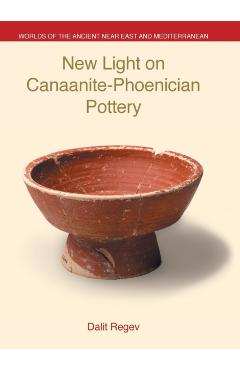
New Light on Canaanite-Phoenician Pottery - Dalit Regev
Preț verificat
Link afiliat — comisionul nu schimbă prețul tău. Cum funcționăm
Detalii
- Brand
- Dalit Regev
- Categorie
- Crafts & Hobbies
- Magazin
- libris.ro
- Cod (GTIN)
- 9781781798225
Descriere de la libris.ro
nThis book follows a continuous line of development from Canaanite pottery to the Phoenician pottery corpus. Phoenician pottery typically is considered to have first emerged in the Iron Age, and most research is limited to the first half of the first millennium BCE. The current analysis, however, shows the Canaanite predecessors as well as the ongoing continuity of Phoenician forms and techniques during the Hellenistic and Roman periods. There are two areas of focus, both of which will be illustrated from materials drawn primarily from the Levant. The first is Phoenician container products, especially amphorae and bottles, although other coarse ware forms are included. The second is red-slip pottery, which was a constant feature of the Phoenician assemblage. These were mainly open vessels that did not contain other products and were valued for their ritual attributes. nThis book follows a continuous line of development from Canaanite pottery to the Phoenician pottery corpus. Phoenician pottery typically is considered to have first emerged in the Iron Age, and most research is limited to the first half of the first millennium BCE. The current analysis, however, shows the Canaanite predecessors as well as the ongoing continuity of Phoenician forms and techniques during the Hellenistic and Roman periods. There are two areas of focus, both of which will be illustrated from materials drawn primarily from the Levant. The first is Phoenician container products, especially amphorae and bottles, although other coarse ware forms are included. The second is red-slip pottery, which was a constant feature of the Phoenician assemblage. These were mainly open vessels that did not contain other products and were valued for their ritual attributes. nThis book follows a continuous line of development from Canaanite pottery to the Phoenician pottery corpus. Phoenician pottery typically is considered to have first emerged in the Iron Age, and most research is limited to the first half of the first millennium BCE. The current analysis, however, shows the Canaanite predecessors as well as the ongoing continuity of Phoenician forms and techniques during the Hellenistic and Roman periods. There are two areas of focus, both of which will be illustrated from materials drawn primarily from the Levant. The first is Phoenician container products, especially amphorae and bottles, although other coarse ware forms are included. The second is red-slip pottery, which was a constant
Mai multe de la libris.ro
 libris.ro
Star Wars Art: Ralph McQuarrie - Ralph McQuarrie
1.096,50RONpreț anterior: 2.193reducere −50% libris.ro
Berkshire Encyclopedia of World History: Second Edition Vol.6 - William H. McNeill, Jerry H. Bentley, David Christian, Ralph C. Croizier, J.R. McNeill, Heidi Roupp, Judith P. Zinsser
979,20RONpreț anterior: 1.958,40reducere −50% libris.ro
Clark's Positioning in Radiography 13E - A. Stewart Whitley, Gail Jefferson, Ken Holmes, Charles Sloane, Craig Anderson, Graham Hoadley
672RONpreț anterior: 1.344reducere −50% libris.ro
Veterinary Hematology, Clinical Chemistry, and Cytology - Mary Anna Thrall
568,47RONpreț anterior: 1.136,93reducere −50%